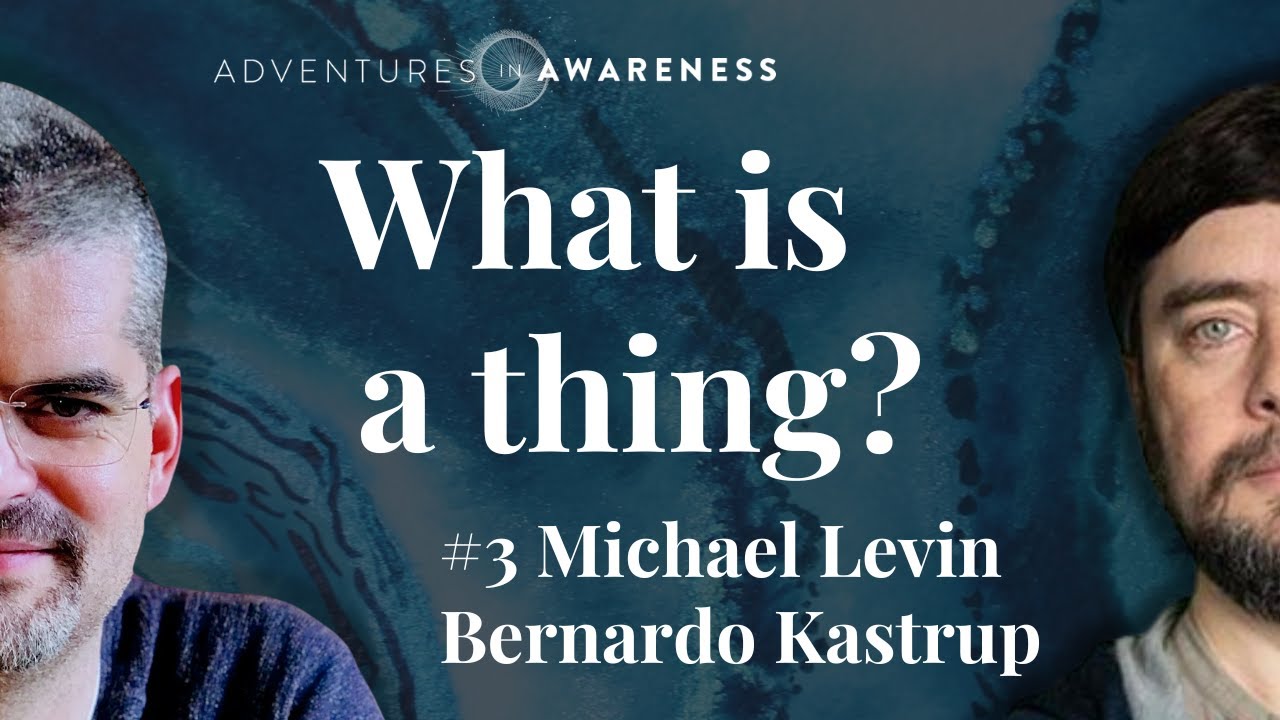
Michael Levin | Bernardo Kastrup #3 - With Reality in Mind
SUMMARY
Michael Levin and Bernardo Kastrup engage in a dialogue on topics including evolution, the Platonic realm, metacognition, and the boundaries of self.
IDEAS:
- Large groups of embryos resist teratogens better than smaller groups or individuals.
- Horizontal information transfer is crucial for embryonic development and group resilience.
- Embryos communicate through ATP and calcium signaling, forming a “hyper embryo.”
- Group effects on development challenge traditional toxicology studies’ accuracy.
- Large embryo groups express unique genes, suggesting collective intelligence.
- Synthetic life forms like xenobots and anthrobots exhibit unexpected capabilities.
- Adult human tracheal cells can self-assemble into motile organisms for healing.
- Evolution explores latent spaces, potentially tapping into a Platonic realm.
- Logical statements may oscillate between truth values, suggesting dynamic Platonic forms.
- Memory could be active data, reshaping itself to fit new contexts and architectures.
- Perspectives are unique to each agent, influencing what is considered a “thing.”
- Active inference and surprise minimization could redefine our understanding of life.
- Algae can form expectations and experience surprise, indicating cognitive abilities.
- Markov blankets in active inference suggest a broader definition of life.
- The Platonic realm might contain dynamic interactions and “chemistry” of concepts.
- Logical paradoxes like the Liar Paradox can be visualized as dynamical systems.
- The universe consists of competing and cooperating perspectives from various agents.
INSIGHTS:
- Embryonic group dynamics challenge individual-centric views of development and toxicity.
- Communication between embryos hints at collective intelligence beyond single organisms.
- Synthetic life forms reveal latent biological capabilities, expanding the definition of life.
- Platonic realm exploration could lead to new engineering and discovery methodologies.
- Memory’s role as active data suggests a fluidity in cognitive processes across time.
- Perspectives shape reality, with each agent defining “things” based on sense-making.
- Active inference aligns with a first-person physics approach to understanding agents.
- The Platonic realm’s dynamics may be more complex than static, timeless forms.
- Logical structures could have inherent dynamical properties, influencing cognition.
- The definition of life may evolve to encompass systems maximizing sense-making.
QUOTES:
- “Large groups of embryos do much better at resisting [teratogens] than small groups."
- "The magic of morphogenesis doesn’t stop at the border of the individual."
- "The universe is basically a giant set of competing and cooperating perspectives."
- "Evolution fundamentally makes beings that extract salience from their situation."
- "The Platonic realm might contain dynamic interactions and ‘chemistry’ of concepts."
- "Memory could be active data, reshaping itself to fit new contexts and architectures."
- "Active inference and surprise minimization could redefine our understanding of life."
- "The universe consists of competing and cooperating perspectives from various agents."
- "Logical structures could have inherent dynamical properties, influencing cognition."
- "The definition of life may evolve to encompass systems maximizing sense-making.”
HABITS:
- Engaging in dialogues on complex topics to expand understanding and perspectives.
- Challenging traditional views by exploring group effects in embryonic development.
- Utilizing synthetic life forms to probe latent biological capabilities and insights.
- Considering the Platonic realm as a source for engineering and discovery methodologies.
- Viewing memory as active data that adapts to new cognitive architectures over time.
- Embracing multiple perspectives to define reality based on individual sense-making.
- Applying first-person physics to comprehend the behavior of cognitive agents.
- Exploring the dynamics within the Platonic realm beyond static forms.
- Investigating logical structures’ dynamical properties for cognitive implications.
- Continuously redefining life to include systems that maximize sense-making.
FACTS:
- Large groups of embryos resist teratogens better than smaller groups or individuals.
- Embryos communicate through ATP and calcium signaling, forming a “hyper embryo.”
- Synthetic life forms like xenobots and anthrobots exhibit unexpected capabilities.
- Adult human tracheal cells can self-assemble into motile organisms for healing.
- Evolution explores latent spaces, potentially tapping into a Platonic realm.
- Logical statements may oscillate between truth values, suggesting dynamic Platonic forms.
- Memory could be active data, reshaping itself to fit new contexts and architectures.
- Perspectives are unique to each agent, influencing what is considered a “thing.”
- Active inference and surprise minimization could redefine our understanding of life.
- Algae can form expectations and experience surprise, indicating cognitive abilities.
REFERENCES:
- Michael Levin
- Bernardo Kastrup
- Angela Tong
- Patrick Grim
- Carl Friston
- Chris Fields
- Mark Solms
- Richard Watson
- Julia Tononi
- Marcus Miller
- The Science of the First Person
- Songs of Mind and Life
- L.E.J. Brouwer
RECOMMENDATIONS:
- Explore group dynamics in embryonic development for insights into collective intelligence.
- Investigate synthetic life forms to uncover latent biological capabilities and applications.
- Consider the Platonic realm’s potential for engineering and scientific discovery methodologies.
- View memory as active data that adapts to new cognitive architectures over time.
- Embrace multiple perspectives to define reality based on individual sense-making.
- Apply first-person physics to comprehend the behavior of cognitive agents.
- Explore the dynamics within the Platonic realm beyond static forms for cognitive insights.
- Investigate logical structures’ dynamical properties for implications in cognition.
- Continuously redefine life to include systems that maximize sense-making for ethical considerations.
- Study algae’s ability to form expectations and experience surprise for cognitive research.