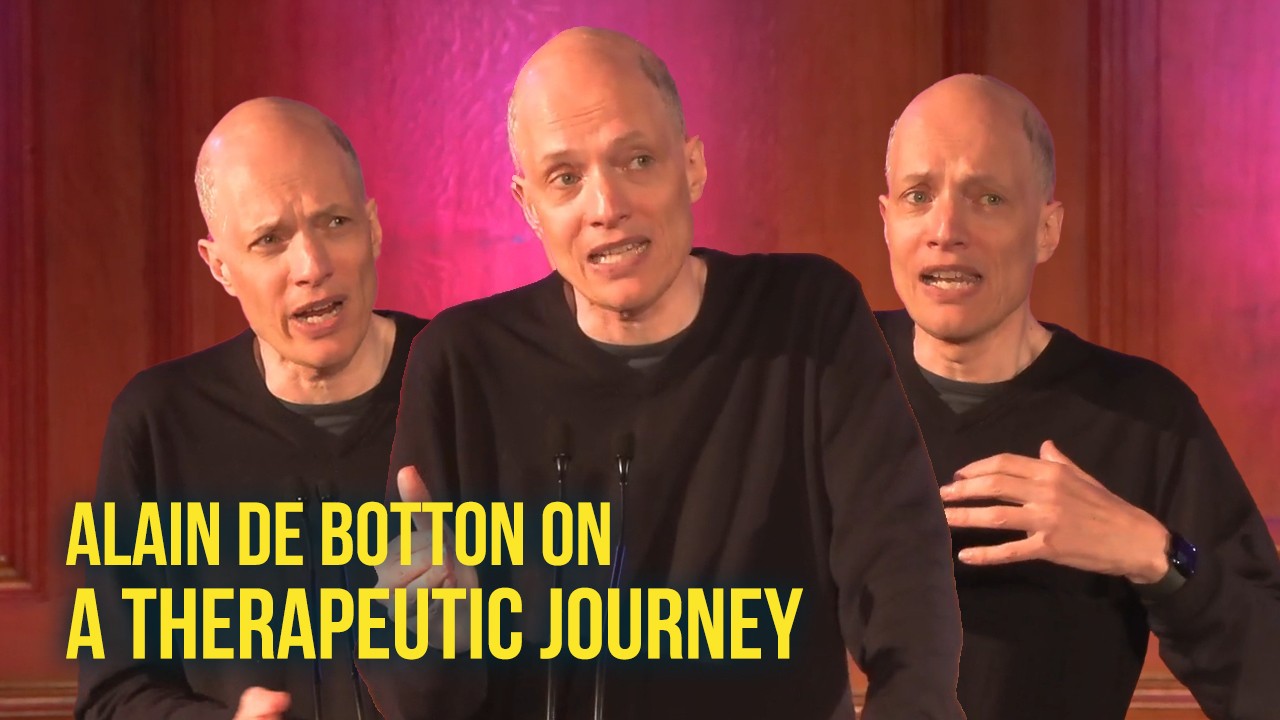
Alain de Botton on A THERAPEUTIC JOURNEY
SUMMARY:
Alain de Botton presents his new book “A Therapeutic Journey,” exploring mental well-being and the darker side of mental experience, following his previous work “The School of Life: An Emotional Education.”
IDEAS:
- Mental well-being is a vast topic, with sanity being a recognition of one’s insanity.
- A healthy mind is an editing machine, prioritizing and compartmentalizing thoughts.
- Defense mechanisms can be both healthy and detrimental to mental processing.
- Mental unwellness erodes the ability to categorize and prioritize thoughts.
- Childhood experiences significantly impact adult mental health and behavior patterns.
- Emotional languages learned in childhood shape trust, self-worth, and communication.
- Correcting emotional languages learned in childhood requires significant effort and therapy.
- Trauma is an undigested, incomprehensible experience at the time it occurs.
- Processing trauma is essential for mental health, as unexamined emotions lead to symptoms.
- Anger that doesn’t understand itself manifests as irritability, insomnia, and physical symptoms.
- The inability to express anger appropriately can lead to a decrease in intimacy and sex.
- Asking partners about annoyances can improve relationships by addressing underlying issues.
- Good childhoods involve feeling central to parents’ world and having emotional needs met.
- Listening empathetically to others can significantly improve relationships and well-being.
- Parents should attune to their children’s perspectives, validating their feelings and experiences.
- A good childhood solidifies personality by allowing children to feel important and heard.
- Adult narcissism often stems from a lack of attention in early childhood, not from overindulgence.
- Mental health involves forgiving oneself, grading problems, and sequencing thoughts effectively.
- Sadism in society is a defense mechanism stemming from unaddressed personal trauma.
- Psychotherapy helps correct distorted expectations formed by family dynamics in childhood.
- Behaviors that seem illogical in adulthood once served a vital protective function in childhood.
- The unconscious mind holds much of our desires and feelings, influencing our conscious life.
- Love and kindness towards oneself are crucial for processing painful truths and achieving mental health.
INSIGHTS:
- Recognizing one’s insanity is a sign of mental health, as it shows self-awareness.
- Childhood shapes our emotional language, affecting lifelong patterns of trust and self-worth.
- Processing childhood trauma is key to understanding current mental health challenges.
- Emotional health requires the ability to forgive oneself and maintain perspective on life’s issues.
- Society’s collective mental health can improve through nurturing individual self-esteem.
QUOTES:
- “The best marker of having at least a measure of sanity is a friendship with one’s more insane sides."
- "A healthy mind is an editing machine that ranks thoughts in order of importance."
- "Mental unwellness erodes the ability to categorize our thoughts and prioritize."
- "Childhood experiences significantly impact adult mental health and behavior patterns."
- "Trauma is an undigested, incomprehensible experience at the time it occurs."
- "Anger that doesn’t understand itself manifests as irritability, insomnia, and physical symptoms."
- "Good childhoods involve feeling central to parents’ world and having emotional needs met."
- "Listening empathetically to others can significantly improve relationships and well-being."
- "Mental health involves forgiving oneself, grading problems, and sequencing thoughts effectively."
- "Sadism in society is a defense mechanism stemming from unaddressed personal trauma."
- "Psychotherapy helps correct distorted expectations formed by family dynamics in childhood."
- "Behaviors that seem illogical in adulthood once served a vital protective function in childhood."
- "The unconscious mind holds much of our desires and feelings, influencing our conscious life."
- "Love and kindness towards oneself are crucial for processing painful truths and achieving mental health.”
HABITS:
- Regularly recognizing one’s own irrational or insane aspects as part of mental health.
- Prioritizing thoughts effectively to maintain focus on important matters in life.
- Compartmentalizing less critical thoughts to manage daily functioning efficiently.
- Seeking therapy to work through emotional languages learned during childhood.
- Actively processing trauma rather than allowing it to manifest as physical symptoms.
- Engaging in conversations about annoyances with partners to resolve underlying issues.
- Practicing empathetic listening to strengthen relationships and personal connections.
- Validating children’s feelings to foster their sense of importance and emotional well-being.
- Embracing self-forgiveness as a daily practice for maintaining mental health.
- Grading problems based on severity to avoid overwhelming stress responses.
FACTS:
- Mental well-being encompasses recognizing one’s own irrational sides as part of sanity.
- Healthy minds prioritize thoughts, compartmentalize emotions, and manage consciousness effectively.
- Childhood experiences shape adult behavior patterns through learned emotional languages.
- Trauma is an experience that cannot be processed or understood at the time it occurs.
- Unprocessed trauma leads to various mental health issues like anxiety, depression, and irritability.
REFERENCES:
- Alain de Botton’s new book “A Therapeutic Journey.”
- Previous work by Alain de Botton: “The School of Life: An Emotional Education.”
- The School of Life organization founded by Alain de Botton.
- Psychoanalyst Donald Winnicott’s distinction between true self and false self.
- Scottish psychoanalyst Ronald Fairbairn’s work on deprived children’s perceptions of their parents.
RECOMMENDATIONS:
- Recognize your own irrational sides as part of embracing mental well-being.
- Prioritize thoughts effectively to maintain focus on important matters in life.
- Seek therapy to work through emotional languages learned during childhood.
- Actively process trauma rather than allowing it to manifest as physical symptoms.
- Engage in conversations about annoyances with partners to resolve underlying issues.