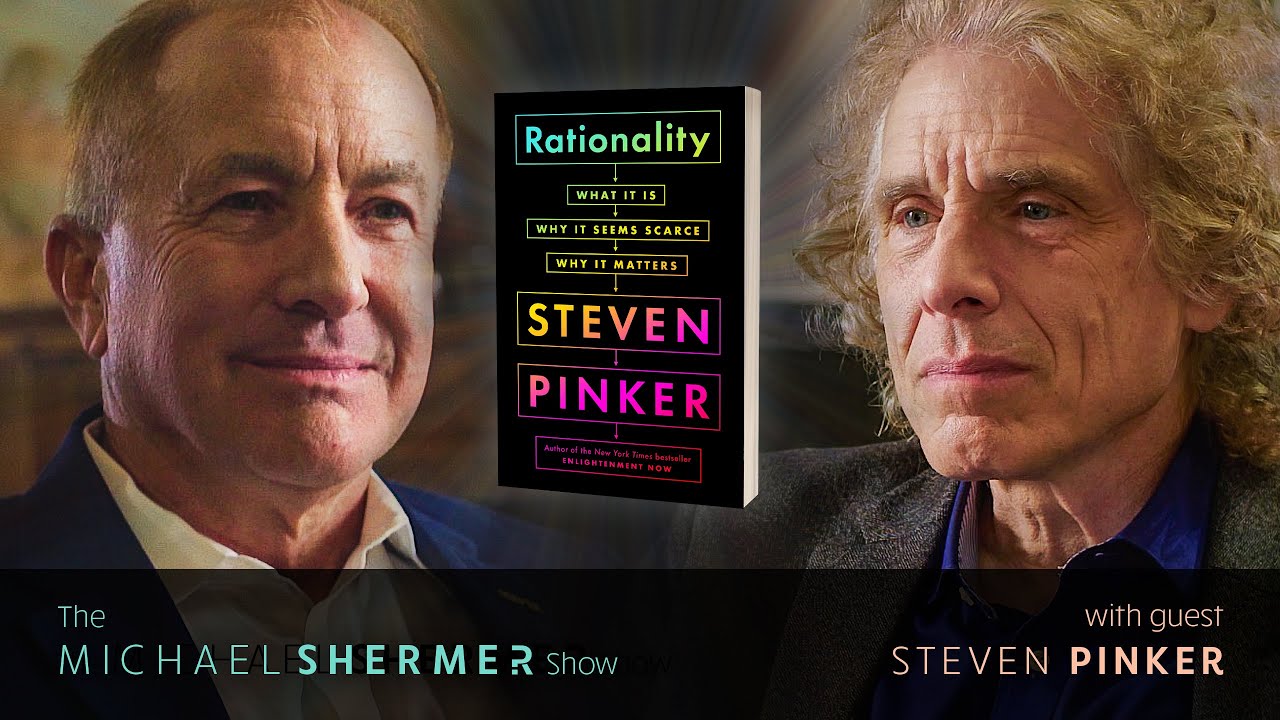
In-Person Convo with Steven Pinker on Rationality: What it is, Why it Seems Scarce, Why it Matters
SUMMARY
Michael Shermer hosts neuroscientist and author David Eagleman on his show, discussing Eagleman’s work, brain plasticity, and rationality, with insights into human nature, the role of technology, and the importance of rational thinking.
IDEAS:
- Human flourishing is enhanced by understanding the world and leveraging knowledge.
- Rationality is not exclusive to Western civilization but inherent to humanity.
- Despite our cognitive abilities, irrational beliefs like QAnon persist.
- Motivated reasoning can lead to irrational beliefs despite evidence.
- Trust in institutions influences acceptance of scientific consensus.
- Science communication should avoid political branding to maintain trust.
- Education should emphasize critical thinking and rationality tools.
- De-biasing programs often fail, but effective pedagogy could improve them.
- Rationality involves goal-oriented thinking, unlike deterministic processes.
- Reason serves our passions, which are prerequisites for rational agents.
- Promoting the virtue of changing beliefs based on evidence is crucial.
- Rationality can guide both moral and material progress for humanity.
- Understanding impartial principles is key to overcoming flawed intuitions.
INSIGHTS:
- Rationality is a universal human trait that transcends cultural boundaries.
- Irrational beliefs often stem from a lack of trust in authoritative sources.
- Effective education in rational thinking is foundational for societal progress.
- The persistence of irrational beliefs highlights the complexity of human cognition.
- Rationality’s role in moral progress is as significant as in material advancements.
- Recognizing and addressing biases can lead to more informed decision-making.
- The ability to change one’s mind when presented with new evidence is a rational virtue.
- Rational thinking allows us to navigate a cosmos indifferent to human concerns.
- Institutions must maintain objectivity to preserve the integrity of scientific consensus.
- Rationality empowers us to improve well-being despite our inherent imperfections.
QUOTES:
- “Our species has dated the origin of the universe, plumbed the nature of matter and energy, decoded the secrets of life."
- "The cognitive wherewithal to understand the world and bend it to our advantage is not a trophy of Western civilization."
- "Rationality is not exclusive to Western civilization but inherent to humanity."
- "Despite our cognitive abilities, irrational beliefs like QAnon persist."
- "Motivated reasoning can lead to irrational beliefs despite evidence."
- "Trust in institutions influences acceptance of scientific consensus."
- "Science communication should avoid political branding to maintain trust."
- "Education should emphasize critical thinking and rationality tools."
- "De-biasing programs often fail, but effective pedagogy could improve them."
- "Rationality involves goal-oriented thinking, unlike deterministic processes."
- "Reason serves our passions, which are prerequisites for rational agents."
- "Promoting the virtue of changing beliefs based on evidence is crucial."
- "Rationality can guide both moral and material progress for humanity."
- "Understanding impartial principles is key to overcoming flawed intuitions.”
HABITS:
- Regularly engage in critical thinking exercises to sharpen rational skills.
- Actively seek out diverse perspectives to challenge personal biases.
- Practice changing one’s mind when presented with compelling evidence.
- Cultivate trust in reputable scientific institutions and their findings.
- Embrace education that emphasizes statistical and probabilistic reasoning.
- Avoid conflating scientific understanding with political ideologies.
- Encourage discussions that explore common ground in contentious topics.
- Promote the value of rational discourse in personal and public spheres.
- Foster an environment where questioning beliefs is seen as a strength.
- Dedicate time to learning about cognitive biases and how to mitigate them.
FACTS:
- Human lifespan has increased from an average of 30 years to over 70.
- Extreme poverty has been reduced from 90% of humanity to less than 9%.
- Death rates from war have decreased by a factor of 20 since historical times.
- Famine death rates have dropped by a factor of 100 compared to the past.
- Vaccines were administered within a year of identifying a 21st-century pandemic.
- Rationality has been instrumental in achieving significant societal advancements.
- Education systems often neglect teaching critical thinking and rationality skills.
- Political branding of scientific issues can undermine public trust in science.
- De-biasing programs have historically shown limited long-term effectiveness.
- Rational agents can find multiple paths to achieve fixed goals, unlike physical processes.
REFERENCES:
- Michael Shermer
- David Eagleman
- The Brain: The Story of You
- Live Wired
- Oregon State University
- Stanford University
- Center for Science and Law
- PBS series “The Brain with David Eagleman”
- Neo-Sensory
- Brain Check
- Car and Driver magazine
- The Atomic Cafe
- Stephen Pinker
- John Brockman
- Noam Chomsky
- The Language Instinct
- How the Mind Works
- The Blank Slate
- The Better Angels of Our Nature
- Enlightenment Now
- Rationality: What It Is, Why It Seems Scarce, Why It Matters
- Brian Dalton (Mr. Deity)
- UC Santa Barbara colleagues
- Daniel Kahneman
- Gerd Gigerenzer
RECOMMENDATIONS:
- Teach critical thinking and rationality skills throughout educational curricula.
- Maintain objectivity in science communication to preserve public trust.
- Explore common ground when engaging with individuals holding irrational beliefs.
- Promote understanding of cognitive biases and their impact on decision-making.
- Encourage the virtue of changing one’s mind when presented with new evidence.
- Foster environments where questioning beliefs is seen as a strength, not weakness.
- Emphasize statistical and probabilistic reasoning in education over traditional math.
- Unbundle scientific issues from political ideologies for clearer public discourse.
- Support institutions that demonstrate commitment to objective scientific consensus.
- Recognize the role of rationality in both moral and material progress for humanity.