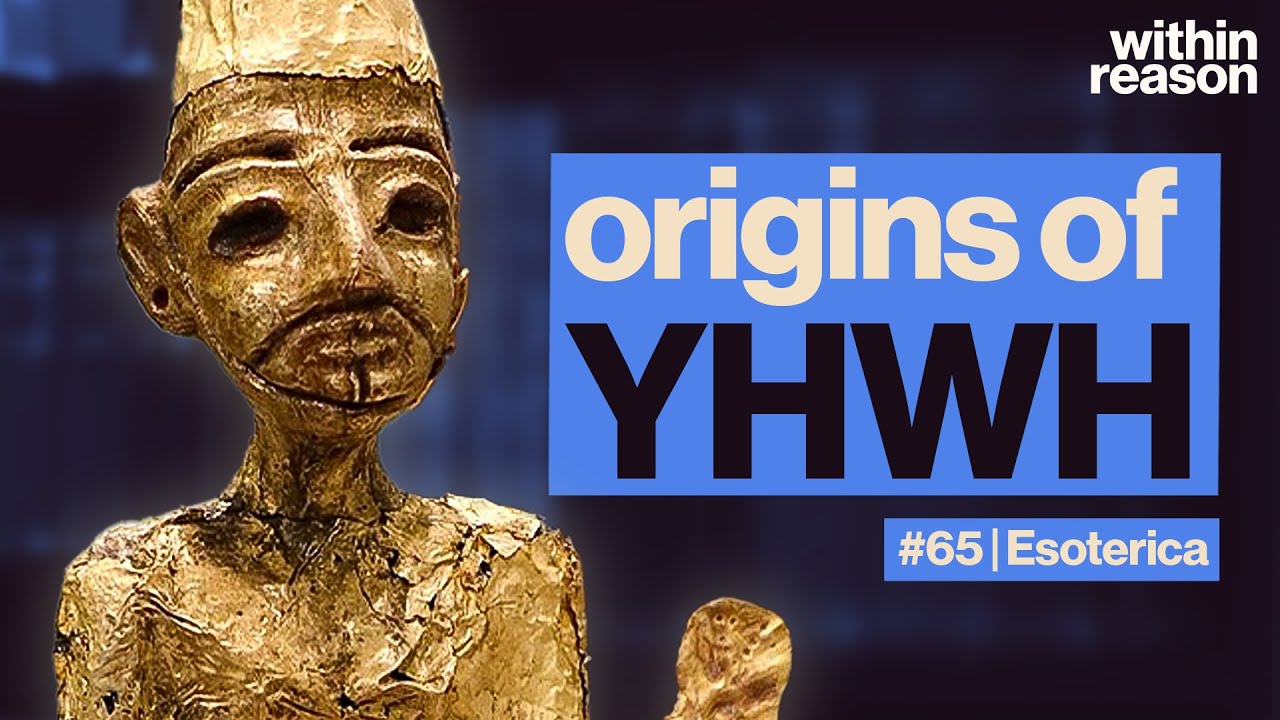
The History of Yahweh - Storm God to Israelite Deity
SUMMARY:
Justin Sledge discusses the enigmatic origins of the deity Yahweh, its pronunciation, meaning, and evolution from a regional god to the monotheistic God of Judaism, Christianity, and Islam.
IDEAS:
- Yahweh’s pronunciation and meaning remain unknown, lost over millennia.
- Academic vocalization “Yahweh” is a best guess based on Hebrew construction.
- The name Yahweh may connect to the Hebrew word “hayah,” meaning existence.
- Critics of monotheism often use “Yahweh” to emphasize Christianity’s polytheistic roots.
- Yahweh’s origins are obscure, possibly imported into Israelite religion.
- The destruction of the Jerusalem Temple severed the tradition of Yahweh’s pronunciation.
- Early attestations of Yahweh appear in Egyptian records and Moabite inscriptions.
- Yahweh was initially associated with storms and war in archaic Israelite texts.
- The Israelite god Yahweh likely originated south of Israel, around Mount Seir.
- The assimilation of Yahweh into the Canaanite pantheon involved syncretism with gods El and Baal.
- The Northern Kingdom’s fall led to a theological shift towards Yahweh monolatry in Judea.
- The Babylonian Exile catalyzed the transition from henotheism to radical monotheism.
- Post-exilic Judaism introduced apocalypticism and a more developed concept of the afterlife.
- Jesus’ crucifixion and resurrection were interpreted differently across early Christian sects.
- Paul’s epistles suggest he viewed Jesus as a divine figure distinct from Yahweh.
- Gnostic traditions viewed Yahweh as a malevolent demiurge, separate from Jesus.
- The concept of the Trinity emerged through Greek philosophical influence on Christian theology.
- Early Christian diversity included various interpretations of Jesus’ nature and salvific role.
INSIGHTS:
- Yahweh’s evolution reflects shifts from regional deity to universal God.
- Monotheism’s rise was influenced by political and theological crises.
- Early Christianity’s diversity challenges uniform theological narratives.
- Gnosticism offered alternative solutions to the problem of evil.
- The Trinity represents a synthesis of Greek philosophy and Christian doctrine.
QUOTES:
- “Yahweh is just an academic vocalization for the Israelite God."
- "The tradition [of Yahweh’s pronunciation] is totally amputated."
- "Yahweh… seems to be connected to the Hebrew word hayah."
- "Yahweh was one God among lots of gods that existed in the Israelite or Canaanite Pantheon."
- "This God [Yahweh] changed… it was an importation into Israelite religion."
- "We don’t know much about the origins of this God [Yahweh]."
- "The earliest attestation that we think we have of Yahweh is… an Egyptian record."
- "Yahweh… seems like this God comes from the south."
- "Yahweh is going to have to beat Baal."
- "The destruction of the Northern Kingdom Israel… leads to a theological shift towards Yahweh monolatry."
- "In that Exile period… monotheism as we know it emerges."
- "Jewish apocalypticism is born out of the theological failure of the old deuteronomistic theology."
- "Paul has some kind of mystical Vision… he sees theorized apotheosized Jesus."
- "The early Theory seems to have been what’s called The Ransom Theory where Jesus literally went into hell and tricked the devil.”
HABITS:
- Engaging in critical analysis of religious texts for deeper understanding.
- Considering historical context to interpret theological developments.
- Distinguishing between academic conjecture and traditional beliefs.
- Acknowledging the diversity within early Christian thought and practice.
- Utilizing archaeological evidence to inform discussions on ancient religions.
- Emphasizing the importance of linguistic nuances in biblical interpretation.
- Recognizing the influence of political events on religious transformations.
- Exploring non-canonical texts to understand marginalized religious perspectives.
- Integrating philosophical concepts into theological frameworks for clarity.
- Challenging uniform narratives by highlighting historical complexities.
FACTS:
- Yahweh’s original pronunciation has been lost for 2,000 years.
- Egyptian records mention a deity similar to Yahweh around 14th century BCE.
- Archaic Hebrew texts associate Yahweh with storms and warfare.
- The Northern Kingdom’s fall influenced Judean theology towards monolatry.
- Babylonian Exile was pivotal in developing Jewish monotheism and apocalypticism.
- Paul’s epistles are among the earliest Christian writings addressing Jesus’ divinity.
- Gnostic traditions present a dualistic view with a malevolent creator demiurge.
- The Trinity concept evolved through Greek philosophy applied to Christian doctrine.
- Early Christianity was not monolithic but comprised various beliefs about Jesus.
- Gnosticism was a significant movement within early Christianity, later deemed heretical.
REFERENCES:
- Justin Sledge
- The Early History of God
- The Origins of Biblical Monotheism
- The Gods and Goddesses of Canaan
- Canaanite Myth and Epic
- Has Archaeology Buried the Bible?
- Beyond the Texts
- The Gnostic Scriptures
- Irenaeus
- Hippolytus
- Epiphanius
- Plato
- Valentinus
- Marcion
- Athanasius
RECOMMENDATIONS:
- Read Mark Smith’s works for insights on Yahweh’s origins and evolution.
- Explore Canaanite myths to understand Israelite religion’s context.
- Consider archaeological perspectives on biblical narratives’ historicity.
- Delve into Gnostic texts for alternative early Christian viewpoints.
- Study Athanasius’ writings on the Trinity for philosophical depth.