Yann Lecun | Objective-Driven AI: Towards AI systems that can learn, remember, reason, and plan
SUMMARY
Yann LeCun, Chief AI Scientist at Meta, presents a talk on Objective-Driven AI at Harvard, discussing the future of AI and its limitations.
IDEAS:
- Yann LeCun criticizes current AI’s inability to understand or plan like humans.
- Objective-driven AI aims for systems with human-level intelligence.
- LeCun proposes self-supervised learning as key to AI advancement.
- Human intelligence is specialized, not general, contrary to AGI beliefs.
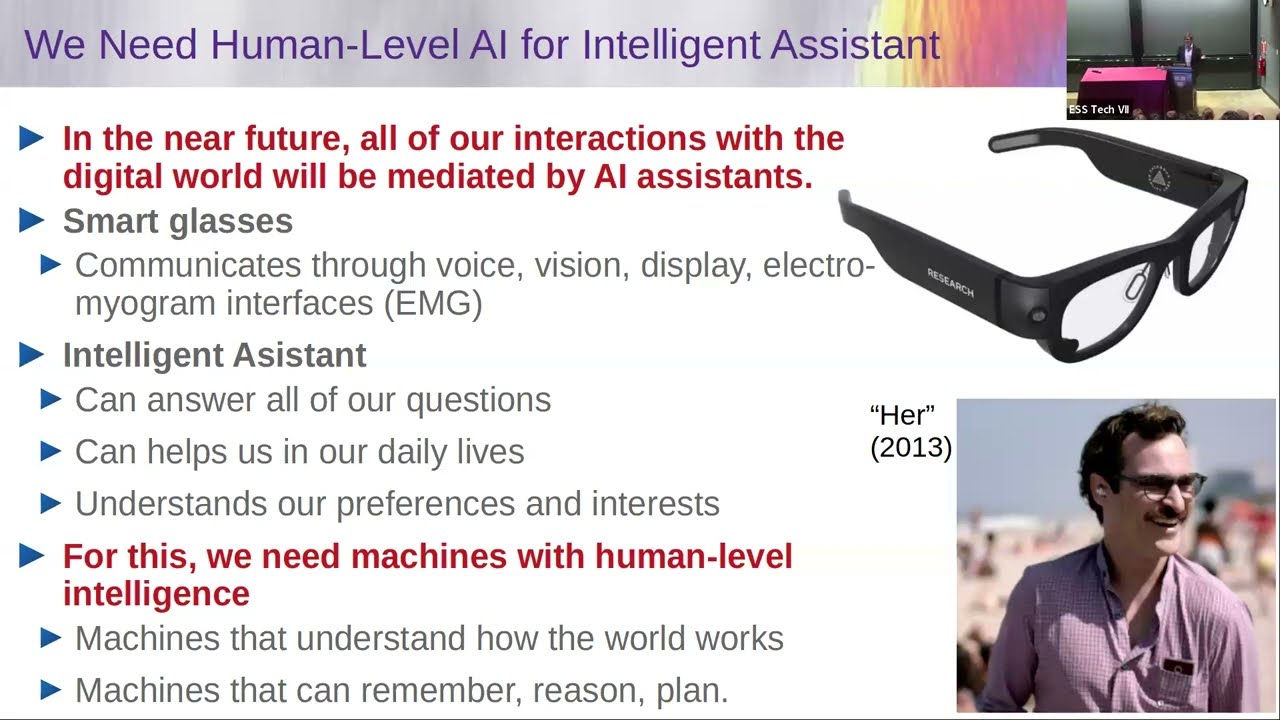
- Future interactions with the digital world will be AI-mediated.
- AI systems lack common sense and reasoning found in humans and animals.
- LeCun suggests that supervised and reinforcement learning are inefficient.
- Self-supervised learning has revolutionized AI’s capabilities recently.
- Generative AI excels in text but struggles with high-dimensional images.
- LeCun emphasizes the need for AI systems to learn world models.
- Objective-driven AI involves optimizing actions to achieve goals.
- Hierarchical planning is crucial for AI to mimic human and animal intelligence.
- LeCun argues against generative models for predicting physical world events.
- Joint Embedding Predictive Architectures (JEPA) are proposed for better predictions.
- Energy-based models are suggested as an alternative to probabilistic models.
- LeCun advocates for open-source AI platforms for diversity and democracy.
- The EU AI Act has both positive and negative implications for AI development.
- LeCun believes human-level AI is still far off and will be a gradual process.
INSIGHTS:
- Current AI lacks the intuitive understanding of the world that humans possess.
- Self-supervised learning is pivotal for the next leap in AI capabilities.
- Generative models are less effective for image-based tasks than text.
- Objective-driven AI could revolutionize how machines interact with the world.
- Open-source AI platforms are essential for maintaining democratic values.
QUOTES:
- “Machine learning sucks. At least compared to what we observe in humans and animals."
- "The goal of AI really is, to build systems that are smart as humans, if not more."
- "Human intelligence is actually not general at all, it’s very specialized."
- "We’re never going to get to human-level AI by just training on language."
- "What we’re missing is systems that are able to learn how the world works."
- "Self-supervised learning has taken over the world."
- "Generative AI excels in text but struggles with high-dimensional images."
- "We need human-level intelligence just for reasons of basically product design."
- "AI systems will essentially constitute a repository of all human knowledge."
- "Open source AI platforms are necessary for even the preservation of democracy.”
HABITS:
- Yann LeCun takes photography pictures, connecting his work with personal hobbies.
- LeCun regularly gives talks at various departments, sharing his expertise.
- He advocates for self-supervised learning in advancing machine learning research.
- LeCun encourages considering proposals and preliminary results in research.
- He supports open-source platforms to democratize access to AI technology.
FACTS:
- The Center of Mathematical Sciences and Applications at Harvard was founded 10 years ago.
- Yann LeCun is the Chief AI Scientist at Meta and a professor at NYU.
- Self-supervised learning has led to significant advancements in AI recently.
- Humans have specialized intelligence, challenging the concept of AGI as general.
- The EU AI Act includes provisions that could impact open-source AI development.
REFERENCES:
- Dan Freed
- S.T. Yau
- Yann LeCun
- Center of Mathematical Sciences and Applications
- Meta
- New York University
- Yann LeCun’s paper on Objective-Driven AI
- New Jersey
RECOMMENDATIONS:
- Explore self-supervised learning to advance machine learning capabilities.
- Consider objective-driven architectures for future AI system development.
- Embrace open-source platforms to ensure diverse and democratic AI access.
- Critically assess generative models’ effectiveness across different domains.
- Engage with interdisciplinary discussions to broaden AI research perspectives.