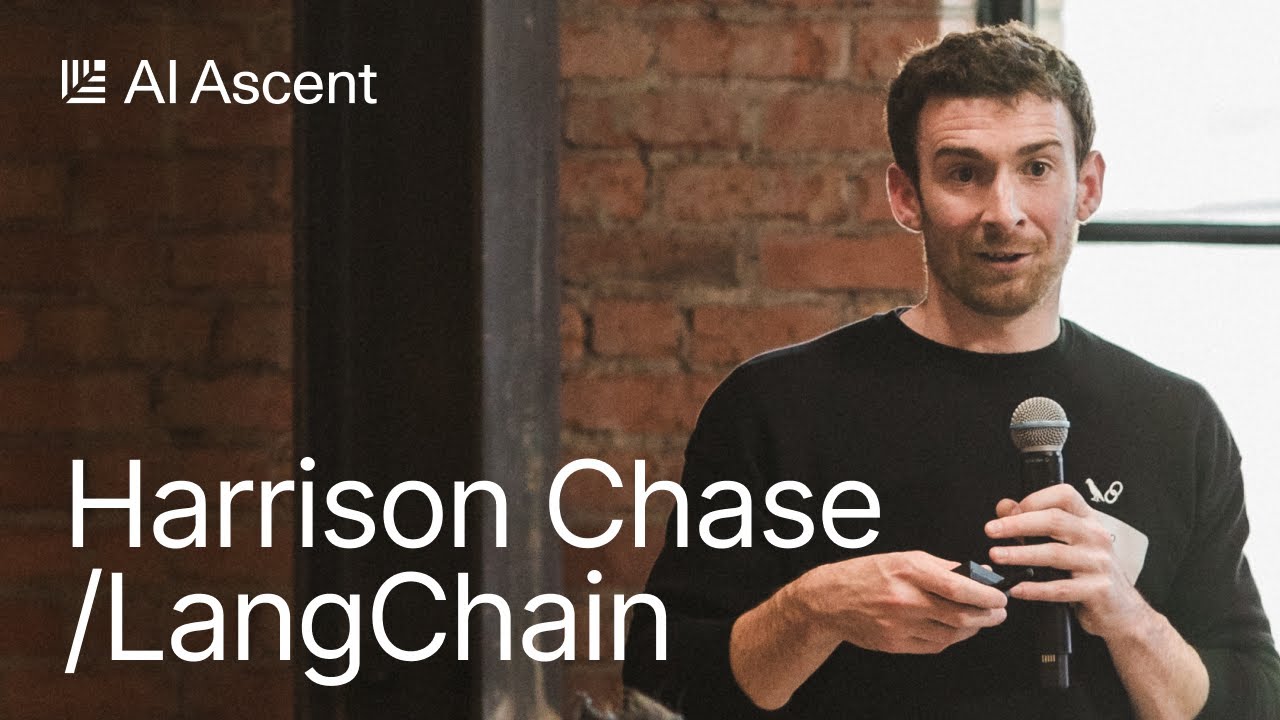
What's next for AI agents ft. LangChain's Harrison Chase
SUMMARY
Harrison Chase discusses AI agents, developer framework Lang chain, and the future of generative AI orchestration platforms at a tech event.
IDEAS:
- Harrison Chase met at last year’s event, sparking interest in this year’s return.
- Lang chain is widely used among attendees, suggesting its popularity.
- Lang chain leads in generative AI orchestration, indicating industry impact.
- Developers focus on making AI agents production-ready and real-world applicable.
- AI agents interact with the world using language models in various forms.
- Simple AI agent operation involves iterative language model consultation.
- Planning, user experience, and memory are key areas for AI agent development.
- Language models need external prompting for reliable planning and execution.
- Flow engineering optimizes performance through design rather than model improvements.
- UX design for agent applications remains an unsolved challenge.
- Human-in-the-loop necessary for reliability but seeks balance with autonomy.
- Rewind and edit features enhance UX by allowing informed decision corrections.
- Memory in AI agents enables learning from interactions and style preferences.
- Procedural memory helps agents remember correct processes for tasks.
- Personalized memory makes user experiences more tailored and engaging.
- Journaling app example shows potential for personalized AI memory use.
- Future agents will likely incorporate both procedural and personalized memory.
- Questions about whether planning prompts are short-term hacks or long-term needs.
- The role of cognitive architectures in future model APIs is uncertain.
- The importance of human engineers in planning AI agent workflows is highlighted.
INSIGHTS:
- Meeting innovators like Harrison Chase inspires return visits to tech events.
- Lang chain’s popularity reflects a significant trend in developer preferences.
- Real-world application of AI agents is a primary focus for developers.
- Effective AI agent operation requires a balance between autonomy and guidance.
- Planning strategies may evolve from developer hacks to integrated model features.
- UX design is crucial for the practicality and adoption of AI agents.
- Memory functions in AI agents are moving towards more personalized interactions.
- The future of AI agents hinges on their ability to learn and adapt.
QUOTES:
- “I’m delighted to introduce Harrison Chase."
- "Lang chain is by far the leading generative AI orchestration platform."
- "Developers spending a lot of time in making this idea of an agent production ready."
- "Running an LLM in a for Loop… you ask it what to do again."
- "Planning, user experience, and memory are key areas for AI agent development."
- "Language models aren’t really good enough to do that reliably."
- "Flow engineering achieves state-of-the-art coding performance."
- "Human in the loop is still necessary because they’re not super reliable."
- "Rewind and edit ability… is a really powerful UX."
- "Memory of Agents… teaching it what to do and correcting it."
- "Procedural memory so it’s remembering the correct way to do something."
- "Personalized memory… remembering facts about a human."
- "Bringing in these personalized aspects will be important for the next generation of Agents.”
HABITS:
- Attending annual tech events to meet and learn from industry innovators.
- Using popular developer frameworks like Lang chain for building applications.
- Continuously exploring new areas of AI agent development for improvement.
- Implementing iterative loops in language model interactions for task execution.
- Incorporating planning and reflection steps to enhance language model performance.
- Balancing human oversight with agent autonomy in user experience design.
- Integrating rewind and edit features to improve agent decision-making processes.
- Teaching AI agents through natural language corrections to refine outputs.
- Utilizing thumbs up signals to reinforce correct agent behavior and learning.
- Experimenting with journaling apps to develop personalized memory in agents.
FACTS:
- Harrison Chase was met at last year’s tech event, prompting this year’s attendance.
- Lang chain is a leading generative AI orchestration platform among developers.
- AI agents are commonly built using the developer framework Lang chain.
- Language models require external prompts for effective planning and execution.
- Flow engineering contributed to Alpha codium’s state-of-the-art coding performance.
- Rewind and edit features are recent UX innovations in agent applications.
- Memory allows AI agents to remember styles and preferences from interactions.
- Procedural memory enables agents to recall the correct process for tasks.
- Personalized memory helps tailor experiences based on individual user facts.
REFERENCES:
RECOMMENDATIONS:
- Attend tech events annually to network with industry leaders like Harrison Chase.
- Use Lang chain for developing generative AI applications effectively.
- Focus on planning, UX, and memory when building AI agents.
- Consider human-in-the-loop as necessary for reliable agent operations.
- Explore rewind and edit UX features for better agent interactions.
- Teach AI agents using natural language corrections for improved learning.
- Develop agents with procedural memory for task-specific process retention.
- Integrate personalized memory into agents for enhanced user experiences.