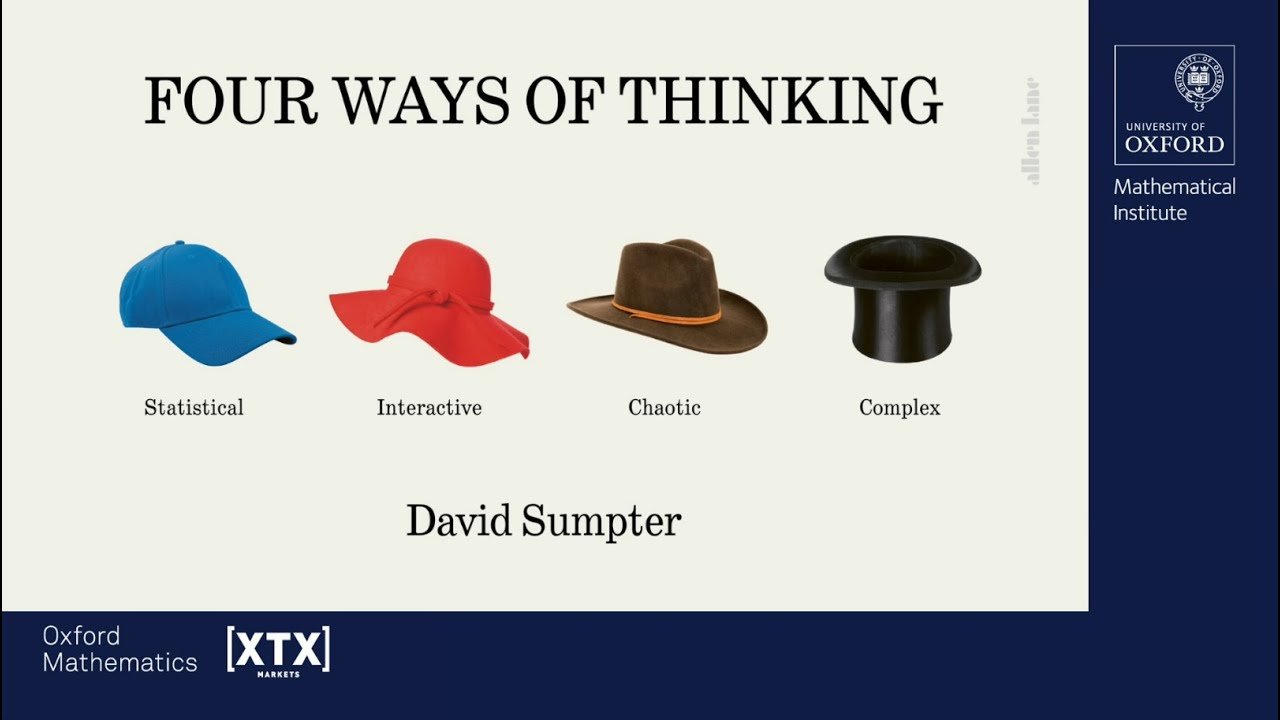
Four Ways of Thinking: Statistical, Interactive, Chaotic and Complex - David Sumpter
SUMMARY:
The speaker, an applied mathematician, discusses the power and limitations of statistical, interactive, chaotic, and complex thinking through examples from science, football, and personal life.
IDEAS:
- Applied mathematics is a tool for understanding the world, not just for calculations.
- Ronald Fisher’s arrogance led to significant contributions in experimental design.
- Statistical thinking can measure aspects like a football player’s response to a goal.
- Grit as a predictor of success is significant but explains only a small variance.
- Fisher’s eugenics advocacy illustrates the misuse of statistics for harmful ideologies.
- Interactive thinking models social interactions and can predict behaviors like applause.
- Lotka’s unbalanced chemical equations model ecological interactions like predator-prey dynamics.
- Chaos theory shows how small initial differences can lead to vastly different outcomes.
- Margaret Hamilton’s programming work for NASA exemplifies precision in the face of chaos.
- Cellular automata demonstrate how simple rules can create complex patterns.
- Complexity can be understood as the shortest description that captures a pattern’s essence.
INSIGHTS:
- Mathematics serves as a lens to interpret and navigate complex realities.
- Historical figures in mathematics often blend brilliance with controversial beliefs.
- The impact of statistics extends beyond academia into sports and societal issues.
- Understanding chaos helps balance control and acceptance in personal and professional life.
- Simple mathematical models can reveal intricate dynamics in natural and social systems.
QUOTES:
- “Mathematics was the toolkit which I could use to get that understanding."
- "Ronald Fisher was an incredibly arrogant young man."
- "Statistics doesn’t actually give you all of the answers."
- "Grit just explains four percent of the variance between people."
- "You shouldn’t confuse the forest for the tree; you’re a tree."
- "A non-smiling person plus two smiley people will become three Smiley people."
- "Chaos is wonderful… yet you kind of have this hum this distribution."
- "If you really care about something control it well; if you don’t care as much just let the chaos take over."
- "A pattern is as complex as the length of the shortest description that can be used to produce it.”
HABITS:
- Uses applied mathematics to understand and solve real-world problems.
- Reflects on historical figures’ contributions and flaws for learning purposes.
- Analyzes football statistics to challenge conventional wisdom about player performance.
- Examines popular TED Talks for statistical validity of claims.
- Applies interactive thinking to model social behaviors like applause dynamics.
- Utilizes chaos theory to manage expectations and control in various situations.
- Embraces programming as a tool to minimize errors in critical tasks like space missions.
- Encourages considering both order and disorder in planning personal life.
- Advocates for simple explanations to capture complex phenomena in science.
- Promotes interdisciplinary approaches combining math, biology, and social sciences.
FACTS:
- Ronald Fisher contributed significantly to experimental design in statistics.
- Grit as a success predictor was popularized by Angela Duckworth’s TED Talk.
- Alfred J. Lotka developed unbalanced chemical equations to model ecological systems.
- Margaret Hamilton programmed the software for the Apollo moon missions.
- Chaos theory originated from weather prediction simulations with small input errors.
- Cellular automata can create complex patterns from simple interaction rules.
- Complexity can be quantified by the brevity of its descriptive code.
REFERENCES:
- Oxford University
- Cambridge University
- Rothamsted Experimental Station
- TED Talks
- Angela Duckworth’s research on grit
- Edward Lorenz’s work on chaos theory
- Margaret Hamilton’s software engineering for NASA
- Cellular automata models
- Twitter coding challenges for graphics
- Kolmogorov’s definition of complexity
RECOMMENDATIONS:
- Explore mathematics beyond calculations to understand complex phenomena.
- Recognize both power and ethical implications of statistical analysis.
- Use statistics responsibly, considering context and effect size.
- Apply interactive thinking to predict social behaviors and patterns.
- Embrace chaos theory to balance control in life and work.
- Learn programming to enhance precision in critical tasks.
- Engage with cellular automata to appreciate complexity from simplicity.
- Challenge yourself with coding tasks that foster creativity within constraints.
- Reflect on complexity through concise yet comprehensive descriptions.
- Encourage interdisciplinary learning for a richer understanding of systems.