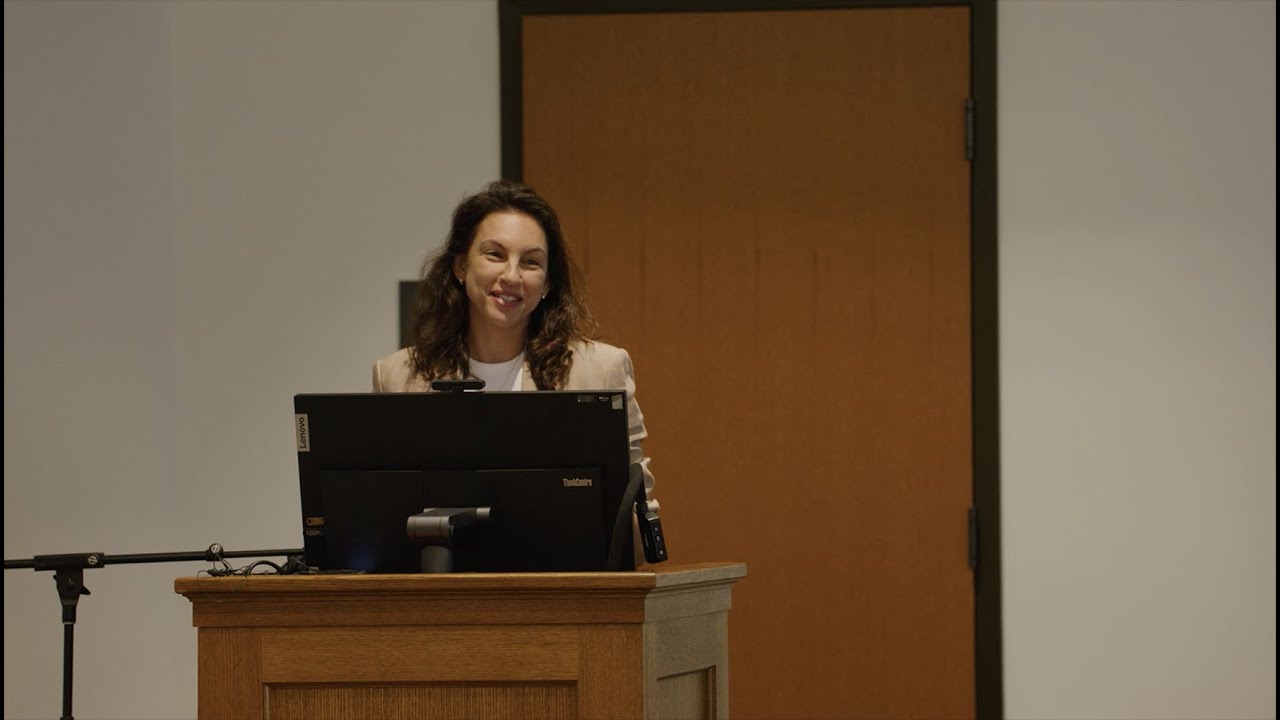
Is Consciousness Fundamental? Conference Talk, September 2023
SUMMARY:
Annika Harris, a science writer, presents at a conference on the topic of consciousness, discussing its fundamental nature and implications for science.
IDEAS:
- Consciousness as felt experience is deeply mysterious and potentially fundamental.
- Terminology clarity is crucial to avoid semantic confusion in discussing consciousness.
- Sentience, as distinct from perception and thought, is a key concept in consciousness studies.
- The challenge in consciousness science is the lack of direct evidence beyond personal experience.
- Split brain phenomena question the reliance on reportability for conscious experiences.
- The “strong assumption” posits consciousness arises from complex processing in brains.
- Two blind assumptions underlie scientific investigations: consciousness in some or all matter.
- Intuitions often mislead scientific understanding, especially regarding consciousness.
- Conscious experiences can exist without external behavior, challenging behavior-based evidence.
- Plant behaviors suggest complex responses without conscious experience, questioning human uniqueness.
- Mycorrhizal networks demonstrate sophisticated plant communication without assumed sentience.
- External behaviors don’t conclusively indicate consciousness; internal experiences remain mysterious.
- Consciousness may not be causal; automatic responses precede conscious awareness.
- Neuroscience reveals much functionality ascribed to consciousness occurs unconsciously.
- Split brain research shows conscious explanations for behavior can be generated subconsciously.
- Panpsychism, while useful, carries problematic connotations for interdisciplinary scientific discussions.
- Consciousness as fundamental raises questions about its role in the structure of reality.
- Meditation and introspection can reveal the illusion of a stable self, impacting combination problems.
- A science assuming consciousness as fundamental could reshape our approach to studying it.
INSIGHTS:
- Consciousness’s fundamental nature challenges traditional scientific assumptions about its emergence.
- Plant behaviors and mycorrhizal networks illustrate complex non-conscious processes in nature.
- The illusion of self, when deconstructed, alters our understanding of consciousness’s unity.
- Introspective practices like meditation can scientifically probe moment-to-moment conscious experiences.
- Future sciences may explore consciousness through experiential methods beyond current limitations.
QUOTES:
- “Consciousness as something that could potentially be fundamental is simply the fact of felt experience."
- "The definition of sentience is feeling or sensation as distinguished from perception and thought."
- "The central challenge to a science of Consciousness is that we can never acquire direct evidence of conscious experiences apart from our own."
- "The strong assumption is that Consciousness arises out of complex processing, namely in brains."
- "We really have to choose between two blind assumptions as our starting points in our scientific investigations."
- "Our intuitions are incredibly accurate; we evolved them for a good reason."
- "Many intuitions also give us false information about the world."
- "We don’t have great intuitions for the very small or the very large or things that happen across long time scales."
- "The truth is that from the outside we just don’t know whether there’s an internal experience being had by any system."
- "Even though we have a very strong intuition for this, we really don’t have good reasons to believe that the conscious feelings themselves are more motivating than the system or its programming."
- "Much of the functionality we ascribe to Consciousness actually takes place in what are considered by modern Neuroscience to be unconscious brain processes."
- "If there are no subjects, the combination problem actually kind of goes away."
- "Consciousness is the water; it’s pervasive, it’s what everything’s about."
- "A science that assumes Consciousness is fundamental might look like work that is in our current scientific framework."
- "We might be able to gain a tremendous amount of ground by experiencing other systems and forces that we don’t naturally perceive.”
HABITS:
- Annika Harris spent over a decade working with scientists to make their work more accessible.
- She engages in editing and ghostwriting to communicate complex scientific ideas clearly.
- Harris practices coaching for talks aimed at general audiences to enhance understanding.
- She wrote a book titled “Conscious” to explore the enigma of consciousness scientifically.
- Harris uses introspective practices like meditation to investigate conscious experiences.
- She interviews scientists and philosophers to bridge gaps in understanding consciousness.
- Harris explores theories in physics with potential connections to consciousness studies.
- She considers meditation a scientific tool for probing moment-to-moment conscious experiences.
- Harris contemplates the implications of consciousness being a fundamental property.
- She works on documentary projects to convey complex ideas about consciousness to the public.
FACTS:
- Annika Harris authored a book on consciousness published in 2019 called “Conscious.”
- The Merriam-Webster Dictionary defines sentience as feeling distinct from perception and thought.
- Split brain research challenges the reliance on reportability for conscious experiences.
- Plants exhibit behaviors analogous to human behaviors down to the level of DNA.
- Mycorrhizal networks facilitate communication and nutrient transfer between plants and trees.
- The Douglas fir and paper birch trees engage in reciprocal carbon exchange relationships.
- Mother trees send more carbon to their kin, increasing seedling survival rates significantly.
- The concept of panpsychism was coined in the 16th century and carries new age connotations.
- Some physicists believe space and perhaps time are emergent from something more fundamental.
- Neuroscientist Anil Seth suggests free will and time perceptions may not reflect objective reality.
REFERENCES:
- Thomas Nagel’s description of consciousness as something it’s like to be an organism.
- Merriam-Webster Dictionary definition of sentience.
- Oxford English Dictionary definition of susceptibility to sensation.
- Daniel Chamovitz’s research on plant behaviors and genetic similarities with humans.
- Suzanne Simard’s research on mycorrhizal networks and tree communication.
- Michael Gazzaniga’s work on split brain patients and The Interpreter phenomenon.
- David Eagleman’s discussions on binding processes and sensory addition work.
- Donald Hoffman’s theory of conscious realism and integrated information theory by Tononi and Koch.
- Sarah Walker’s assembly theory related to life and potentially consciousness.
RECOMMENDATIONS:
- Clarify terminology when discussing consciousness to prevent semantic misunderstandings.
- Consider plant behaviors as models for complex non-conscious processes in nature.
- Use meditation as a tool for scientific investigation into conscious experiences.
- Explore theories where consciousness is fundamental to understand reality’s structure better.
- Engage with interdisciplinary discussions without relying solely on terms like panpsychism.
- Investigate how introspection can reveal illusions such as the stable self-concept.
- Examine how future sciences might study consciousness through experiential methods.
- Pay attention to sensory addition research for insights into expanding human perception.
- Consider psychedelics research for potential insights into consciousness studies.
- Encourage young scientists to pursue innovative approaches to understanding consciousness.