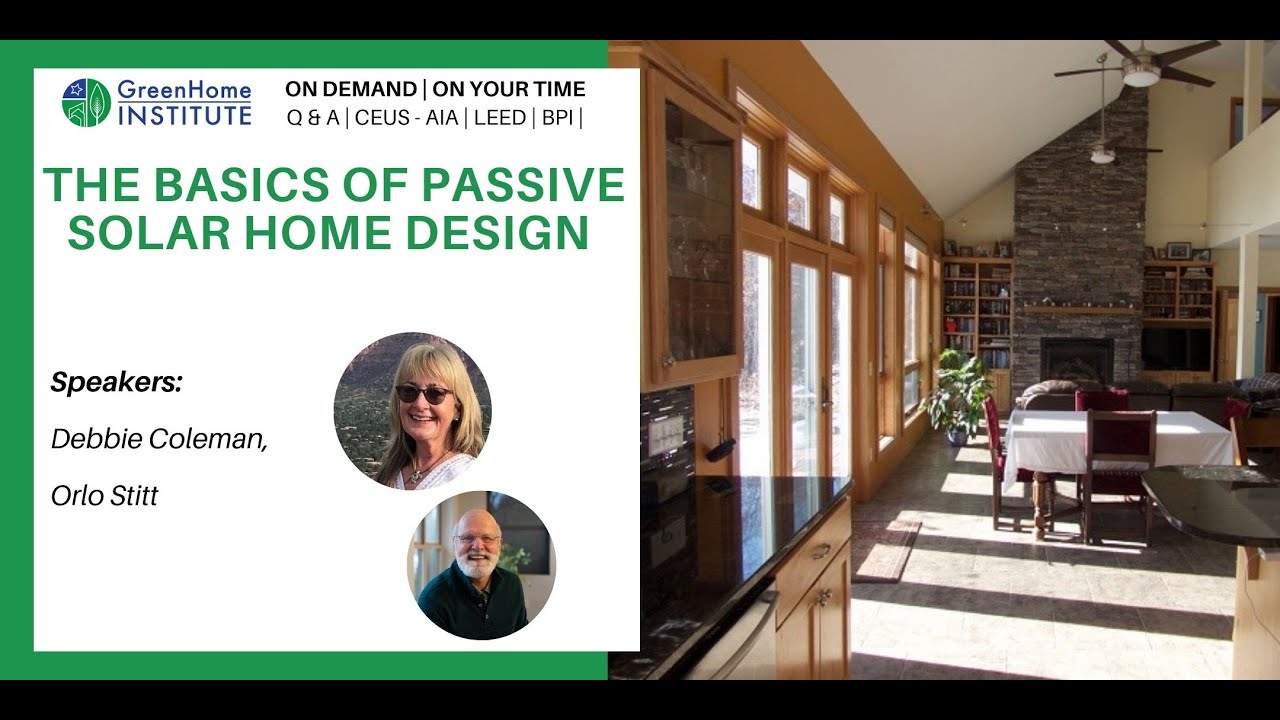
The Basics of Passive Solar Home Design
SUMMARY:
Brett Little moderates a session on passive solar home design, featuring insights from Debbie Coleman and Orla, with a focus on energy efficiency, sustainable living, and the role of technology in home heating and cooling. The session includes discussions on design tools, examples of passive solar homes, and the importance of education in green building practices.
IDEAS:
- Passive solar design uses the sun to warm and brighten homes.
- Orientation, windows, overhangs, and thermal mass are key design components.
- South-facing walls receive significant sun energy, useful for heating.
- Overhangs can provide shade in summer, allowing sun in winter.
- Thermal mass stores excess heat, with slab-on-grade being a favorite.
- Passive solar can contribute to passive survivability during power outages.
- Active solar elements like PV panels can complement passive design.
- Right-sized HVAC systems enhance comfort in passive solar homes.
- Passive solar principles can be integrated into various building standards.
- Tools like PV Watts can quantify passive solar energy gains.
- Passive solar features should be highlighted in real estate listings.
- Education is crucial for builders and buyers to understand passive solar benefits.
- Code officials may need more education on passive solar advantages.
- Stretch codes are beginning to recognize passive solar and cooling benefits.
- Passive solar homes can be cost-competitive with traditional homes.
- Proper insulation and air sealing are fundamental for passive solar efficiency.
- Passive solar design should be considered from the project’s inception.
- Retrofitting existing homes with passive solar features can be challenging.
- Passive solar homes often sell faster due to their energy efficiency.
- Solar heat gain coefficient is important for window selection in passive design.
- Mini-split HVAC systems can be effective in passive solar homes.
- Passive solar subdivisions create communities focused on sustainability.
INSIGHTS:
- South-facing walls are pivotal for harnessing winter sun in passive design.
- Overhangs serve dual purposes: blocking summer heat, allowing winter warmth.
- Slab-on-grade foundations offer inherent thermal mass for heat storage.
- Education in green building practices is key for wider passive solar adoption.
- Real estate appraisals should reflect the value of passive solar features.
- Stretch codes indicate a growing recognition of passive design benefits.
- Cost-effectiveness of passive solar rivals that of conventional homes.
- Proper framing and insulation are as vital as orientation in passive design.
- Passive solar principles align with holistic approaches to green living.
- Tools like PV Watts bridge the gap between theory and practical application.
QUOTES:
- “Every home is a solar home; we can either use the sun’s light and energy or let it go to waste."
- "The best energy-efficient home is the smallest one that meets your needs."
- "Passive survivability means maintaining livable conditions during extended power or heating fuel loss."
- "Passive solar along with increased insulation can reduce the number of PV panels required."
- "The goal is passive survivability: buildings should be livable without utilities for weeks."
- "True north and magnetic declination are crucial for accurate passive solar orientation."
- "The sun’s seasonal movement is a basic concept in passive solar design."
- "Passive cooling strategies include operable windows for airflow and balanced light."
- "Passive solar is part of the holistic design process done before construction."
- "Passive solar design tools help visualize and quantify sun exposure and shading."
- "Passive solar features should be highlighted in real estate listings for better marketability."
- "Education is crucial for builders and buyers to understand passive solar benefits."
- "Stretch codes are beginning to recognize passive solar and cooling benefits."
- "Passive solar homes can be cost-competitive with traditional homes.”
HABITS:
- Use a Solar Pathfinder tool to assess potential shading on building sites.
- Incorporate operable windows for natural ventilation in passive design.
- Utilize insulated curtains to reduce heat loss through windows at night.
- Design homes with compact footprints to minimize energy consumption.
- Seal homes tightly to prevent air leakage and improve energy efficiency.
- Right-size HVAC systems based on reduced loads from passive features.
- Use daylight basements to leverage earth’s insulation in home designs.
- Monitor declination to ensure accurate orientation for passive solar gain.
- Engage with code officials to educate them on passive solar advantages.
- Advocate for appraisal systems that recognize the value of passive features.
FACTS:
- South-facing walls receive almost as much sun energy as roofs do.
- Passive solar can reduce space heating and cooling by 50 percent or more.
- The Solar Pathfinder tool allows tracing shade patterns even on cloudy days.
- Passive solar heating requires no active or moving parts for functionality.
- In the U.S., heating and air conditioning account for roughly 50 percent of home energy use.
- A well-insulated roof, walls, floors, and high-quality windows are prerequisites for passive solar design.
- The American Solar Energy Society hosts a national tour showcasing solar projects annually.
- Passive solar principles can be integrated into various building standards like LEED and Energy Star.
- Stretch codes indicate a growing recognition of passive design benefits by building authorities.
- Passive solar homes often sell faster due to their energy efficiency and lower operating costs.
REFERENCES:
- Mitsubishi comfort.com
- Reem.com
- Green Home Institute
- The Sun Inspired House
- The Passive Solar Energy Book
- Passive Solar Design Strategies
- The Pretty Good House
- The House Needs to Breathe…Or Does It?
- Alex Wilson
- George Keck
- Frank Lloyd Wright
- Allison Bailes
- Mark Rosenbaum
- Michael Reynolds
- American Solar Energy Society
- Oak Ridge National Laboratory
RECOMMENDATIONS:
- Utilize Solar Pathfinder tool for assessing potential shading on sites.
- Incorporate operable windows for natural ventilation in designs.
- Use insulated curtains to reduce heat loss through windows at night.
- Design homes with compact footprints to minimize energy consumption.
- Seal homes tightly to prevent air leakage and improve efficiency.
- Right-size HVAC systems based on reduced loads from passive features.
- Use daylight basements to leverage earth’s insulation in designs.
- Monitor declination to ensure accurate orientation for passive gain.
- Engage with code officials to educate them on passive advantages.
- Advocate for appraisal systems recognizing value of passive features.