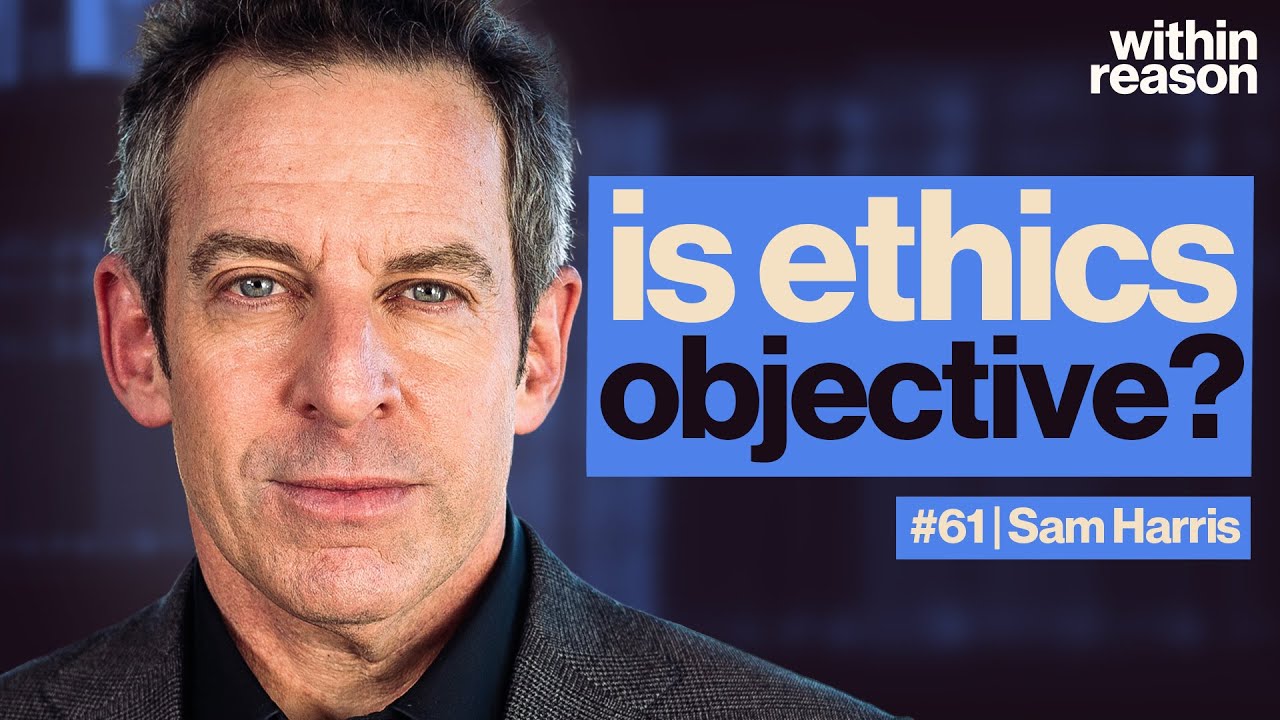
Debating The Moral Landscape With Sam Harris
SUMMARY
Sam Harris discusses the moral landscape, objective morality, and the role of spirituality in ethics on the “Within Reason” podcast.
IDEAS:
- Objective morality can be proven through experiences like touching a hot stove.
- New Atheism’s critique of religion lacks a constructive ethical framework.
- Sam Harris argues for objective morality based on human well-being.
- The moral landscape challenges relativism and asserts science can measure values.
- Harris suggests objective truths about subjective states are possible.
- Worst possible misery for everyone is the foundation for moral truths.
- The moral landscape is a metaphor for peaks and valleys of human experience.
- Harris criticizes the is-ought distinction and advocates for moral realism.
- He equates moral truths with logical consistency and evidence-based beliefs.
- Harris believes in a completed science of the mind to understand morality.
- He argues that moral truths exist even if they don’t intrinsically motivate.
- Harris sees a double standard in how we treat ethics versus other sciences.
- He contends that moral truths are as real as mathematical or scientific truths.
- Harris suggests that moral truths are not just personal biases or cultural conventions.
- He believes that moral truths can guide us towards better states of existence.
- Harris acknowledges the difficulty in knowing moral truths in practice.
- He argues that moral truths can be understood in principle, despite practical uncertainty.
- Harris believes that moral truths are not dependent on personal motivation or persuasion.
- He suggests that moral truths are about navigating towards better experiences.
- Harris sees the recognition of bad experiences as a universal human trait.
INSIGHTS:
- Objective morality is rooted in universally bad experiences, like severe pain.
- Moral truths are akin to logical consistency, not mere cultural conventions.
- Understanding moral truths in principle is distinct from knowing them in practice.
- Moral realism posits that certain states of existence are objectively better.
- The concept of ‘should’ in morality is analogous to logical ‘oughts.‘
QUOTES:
- “The worst possible misery for everyone is bad, and anything else would be better."
- "Moral landscape challenges relativism, asserting science can measure values."
- "Objective truths about subjective states are possible and necessary for ethics."
- "Moral truths exist even if they don’t intrinsically motivate or persuade."
- "We treat ethics with a double standard compared to other branches of science.”
HABITS:
- Sam Harris practices meditation to understand subjective experiences objectively.
- He reads extensively about human well-being and ethics for his work.
- Harris engages in public speaking to advocate for objective morality.
- He reflects on the role of spirituality in life without religious dogma.
- Harris continuously explores the intersection of science and morality.
FACTS:
- Sam Harris is known for advocating objective morality based on well-being.
- The moral landscape metaphor represents peaks and valleys of human experience.
- Harris argues against the is-ought distinction in moral philosophy.
- He believes in a completed science of the mind to understand morality fully.
- Harris sees moral truths as guiding principles towards better experiences.
REFERENCES:
- The Moral Landscape
- Waking Up
- Richard Dawkins
- Dan Dennett
- Christopher Hitchens
- William Lane Craig
- Global Atheist Convention
RECOMMENDATIONS:
- Practice meditation to gain insight into subjective experiences objectively.
- Read “The Moral Landscape” to understand Harris’s view on objective morality.
- Explore the intersection of science and ethics for a deeper understanding.
- Reflect on personal biases when considering moral and ethical questions.
- Engage with diverse perspectives to challenge and refine your ethical views.