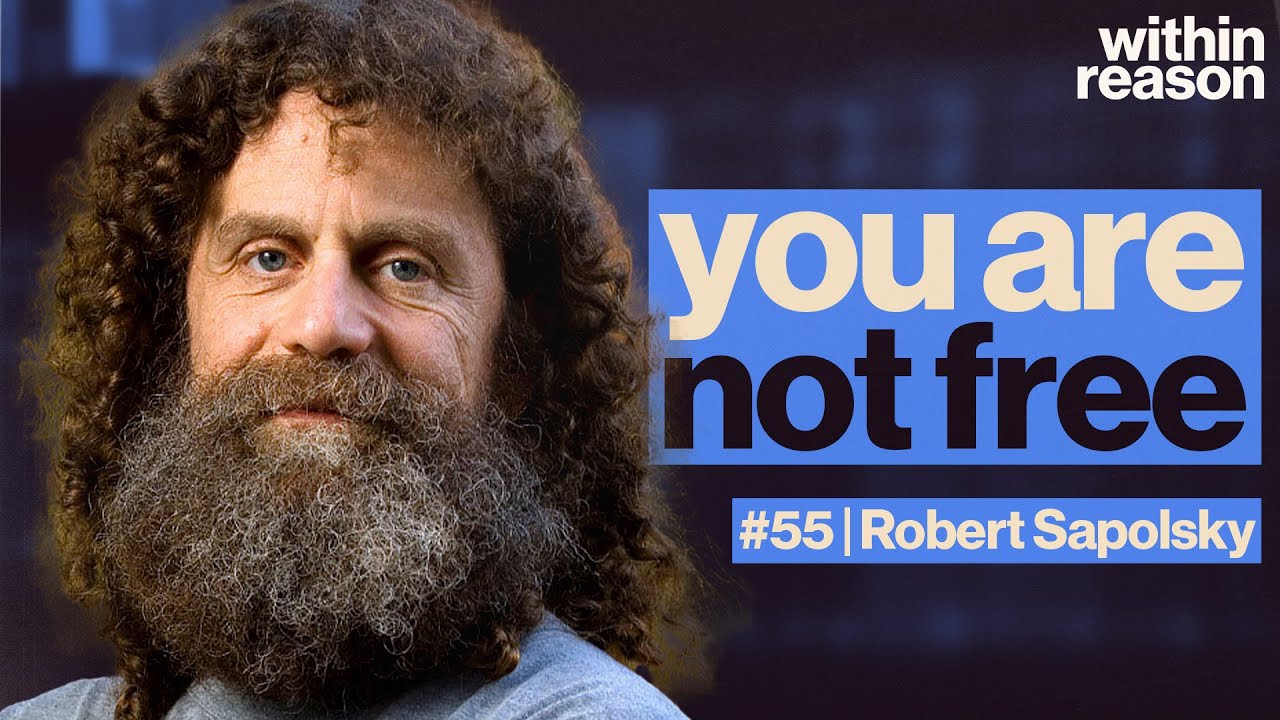
There's No Free Will. What Now? - Robert Sapolsky
SUMMARY
Robert Sapolsky discusses his book “Behave” on the Within Reason podcast, challenging the concept of free will and exploring human behavior’s biological and environmental determinants.
IDEAS:
- Sapolsky, a biologist, views human behavior through a neuroscientific lens.
- He argues that free will is an illusion, shaped by biological and environmental factors.
- Sapolsky suggests our actions are the sum of our biological and environmental luck.
- Different scientific disciplines converge on determinism, leaving no room for free will.
- The “hungry judge phenomenon” shows how physiological states influence decisions.
- Judges’ parole decisions are significantly affected by the time since their last meal.
- Sapolsky believes that every action is influenced by factors beyond our control.
- He posits that there is no separate “me” inside the brain immune to external influences.
- The randomness in neuron behavior is not truly random but has evolved mechanisms.
- Quantum indeterminacy does not provide a basis for free will in human behavior.
- Phineas Gage’s case illustrates how physical brain changes can alter personality.
- Our ancestors’ environments and cultures shape our current behaviors and beliefs.
- Removing the illusion of free will could lead to a more humane world.
- Sapolsky argues against the concepts of blame, punishment, praise, and reward.
- He suggests that understanding the lack of free will can reduce societal biases.
- Recognizing determinism can be challenging but may lead to societal improvements.
- Motivation and ambition are difficult to reconcile with the absence of free will.
- Sapolsky advocates for gratitude for unearned gifts rather than pride in achievements.
- He acknowledges the difficulty in living consistently with a disbelief in free will.
- The concept of free will is hard to define and often self-contradictory when analyzed.
- Understanding our machinelike nature can be emotionally challenging for humans.
INSIGHTS:
- Human behavior is a complex interplay of past influences, not individual autonomy.
- Physiological states like hunger can have profound effects on decision-making processes.
- The concept of free will crumbles under interdisciplinary scientific scrutiny.
- Randomness in brain function is an evolved trait, not an avenue for free will.
- Historical shifts in understanding human behavior reflect a move away from free will.
QUOTES:
- “We are nothing more than the sum of our biological luck over which we had no control."
- "There’s not a crack anywhere in that edifice in which you could shoehorn in free will."
- "A judge right after they had lunch you had about a 60% chance of parole."
- "Randomness is not like the basis for free will; it’s just as incompatible as extreme determinism."
- "Phineas Gage was no longer Gage… he had a massive transformation in his personality."
- "We are the outcome of the biological environmental luck that started way back when."
- "Blame and Punishment never make any sense whatsoever in any realm of human life."
- "For most people, getting rid of Free Will is a wonderful thing; it makes the world more humane."
- "We’re smart enough to know our Machin this and we have the tools to try to deny that."
- "The notion that we’re just observing a machine in action is really challenging.”
HABITS:
- Sapolsky approaches human behavior from a neuroscientific perspective.
- He consistently challenges the notion of free will in his professional work.
- Sapolsky integrates knowledge from various scientific fields to support his views.
- He examines historical cases like Phineas Gage to understand behavior changes.
- Sapolsky reflects on personal difficulty in living without belief in free will.
FACTS:
- Judges’ parole decisions are influenced by their physiological state, like hunger.
- Phineas Gage’s personality changed drastically after a brain injury from an accident.
- Cultures of honor have different physiological responses due to ancestral practices.
- Collectivist culture mothers sing lullabies more quietly than individualist cultures.
- Certain gene variants can predispose individuals to obesity regardless of behavior.
REFERENCES:
RECOMMENDATIONS:
- Read Sapolsky’s book “Behave” to understand the determinants of human behavior.
- Consider interdisciplinary approaches when examining the concept of free will.
- Reflect on how ancestral environments influence contemporary behaviors and beliefs.
- Recognize the role of physiological states in decision-making and judgment.
- Explore historical cases like Phineas Gage to learn about personality changes.